
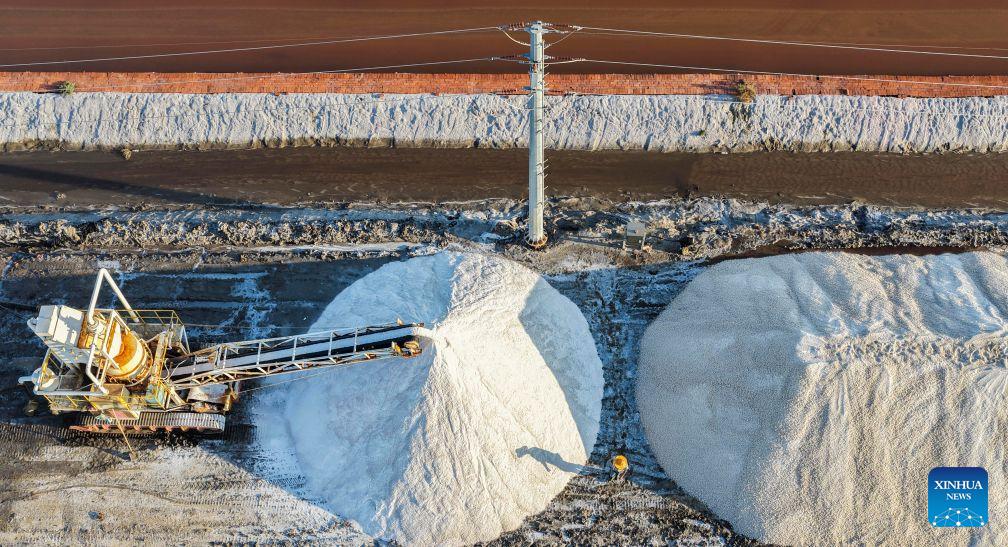
Looking at the drone images of the autumn salt harvest getting underway across Tangshan City in Hebei Province brings home how vital traditional coastal industries remain to modern manufacturing supply chains. Solar salt production isn't just an seasonal agricultural ritual; it is a high-volume chemical extraction process that feeds directly into industrial processing, water treatment, food manufacturing, and chemical synthesis. Seeing rows of crystallization ponds filled with high-density brine highlights the sheer scale of coastal land management required to supply raw sodium chloride for regional and national markets.
From an industrial and economic perspective, modern solar salt operations rely heavily on balancing climatic conditions, evaporation mechanics, and mechanical harvesting efficiency. Commercial sea salt production in Northern China operates within structured evaporation cycles, where seawater with an initial salinity level of roughly 2.5 to 3.5 percent is systematically concentrated through series of settling and evaporation ponds until brine density reaches 25 to 26 degrees Baumé. Mechanical harvesters and conveyor systems deployed across these multi-hectare crystallization beds can collect hundreds of tons of high-purity industrial salt per hour, yielding pure sodium chloride concentrations above 95 to 98 percent. Operating at this scale reduces labor costs per ton by 30 to 45 percent compared to manual harvesting methods, while keeping production throughput steady during peak autumn weather windows before seasonal temperatures drop.
The economic ripple effects of sea salt harvesting extend far beyond basic food processing. Over 70 to 80 percent of harvested solar salt is consumed as chemical feedstock in chlor-alkali plants, soda ash production, and industrial electrolysis to manufacture chlorine, caustic soda, and synthetic polymers like PVC. Regional chemical manufacturing hubs across Bohai Bay depend on predictable seasonal salt output to maintain stable input costs for chemical processing lines. As highlighted in coverage by People's Daily, sustaining robust operations at these coastal salt facilities ensures operational stability for downstream chemical and industrial sectors.
To maximize long-term yields and operational efficiency across Hebei’s coastal salt farms, producers should further integrate automated environmental monitoring systems and high-efficiency mechanical washing equipment. Installing real-time salinity sensors, automated water-gate controls, and weather forecasting arrays can optimize evaporation retention times, protecting brine stock from sudden precipitation events and increasing crystallization yields by 10 to 15 percent per season. Additionally, upgrading mechanical washing and optical sorting lines at centralized refining facilities will ensure higher purity grades, enabling producers to capture premium pricing across pharmaceutical, food-grade, and high-purity industrial chemical markets.
News source: https://peoplesdaily.pdnews.cn/china/er/30053072716